+971 56 978 6395 info@brandingblitz.com

Custom Stamps and Seals Dubai, Abu Dhabi & UAE

"Every impression carries your identity."

From bilingual company stamps for UAE trade licence documents to wax seals for luxury gifting, our Al Quoz workshop produces precision office and ceremonial stamps in-house. Trodat and Colop stamp bodies, laser-engraved rubber plates, solid brass wax seal heads and embossing dies — all made to order with same-day dispatch on standard sizes.

Key Features

  • Self-inking, pre-inked and traditional rubber
  • Bilingual Arabic and English layouts
  • Trodat and Colop original bodies
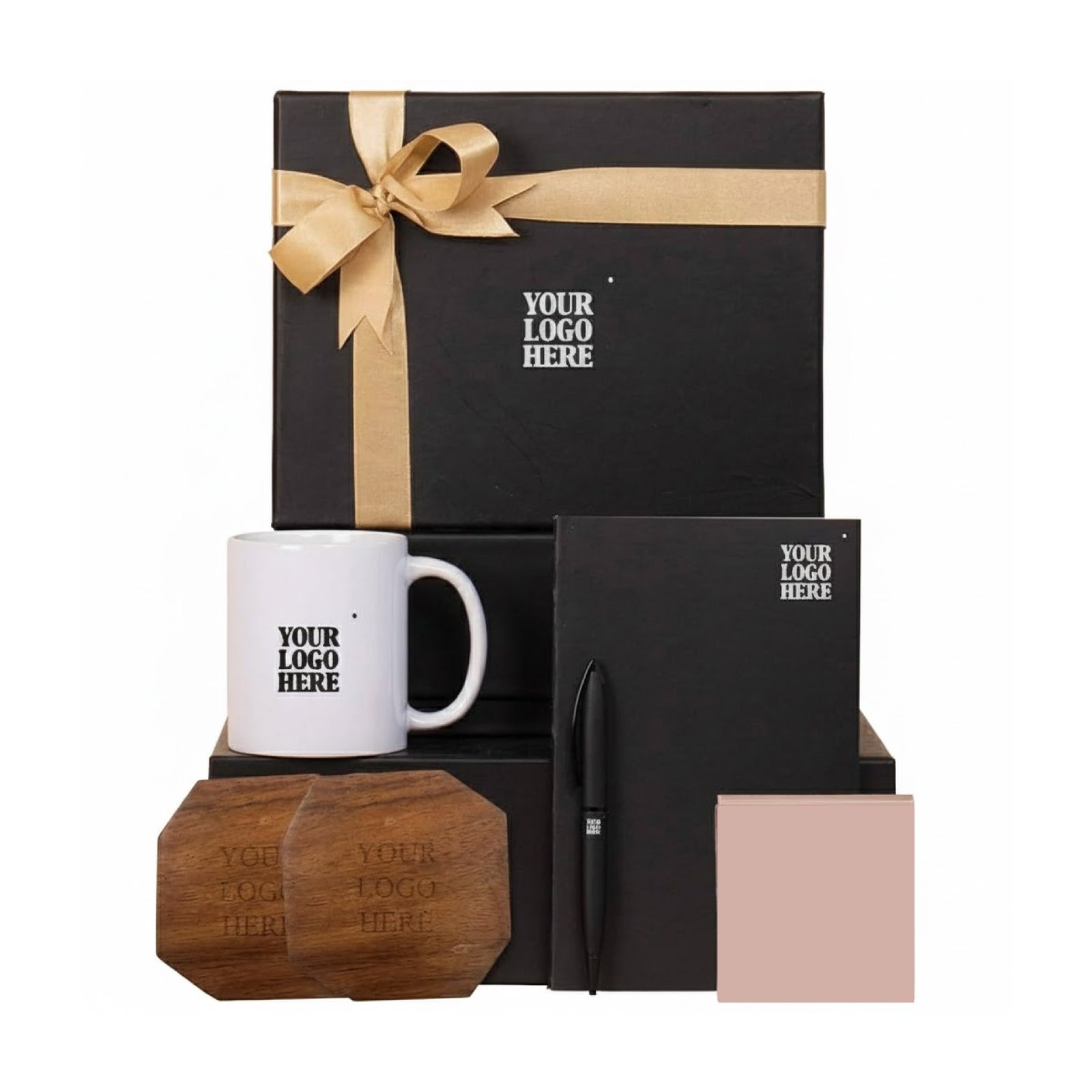
  • Solid brass wax seal heads
  • Same-day dispatch across Dubai
  • Refill pads and ink stocked in-house
Get Instant Quote

Perfect For

Company stamps for trade licence work, notary and court seals, HR onboarding kits, wedding invitation wax seals, and luxury retail gifting across Dubai, Abu Dhabi and the wider UAE.
Thank You!

Your quote request has been submitted successfully.

We'll get back to you within 24 hours.

The Six Stamp Families We Produce In Dubai

A stamp is one of the smallest branded objects your business will ever own, and yet it appears on every contract, every invoice, and every closing ceremony of a bank account opening. What follows is a plain-spoken guide to the six stamp families we manufacture in our Al Quoz workshop, along with when each one is the right choice for a UAE business. We have written this page so that whether you are a startup founder collecting the last item on your DED checklist or a wedding planner sourcing 300 branded envelopes for a Palace Downtown reception, you find the answer without having to phone us first.

Self-Inking Stamps

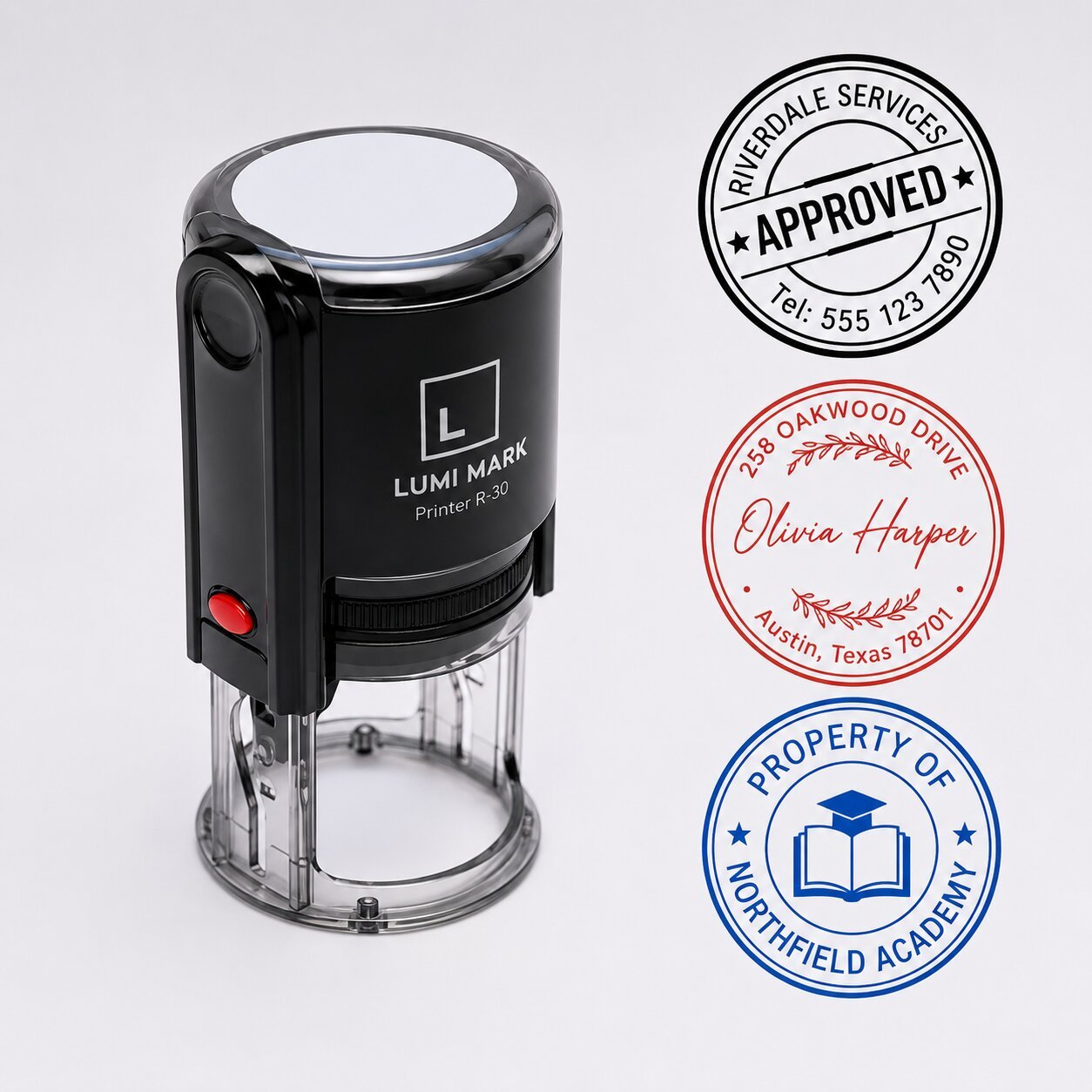
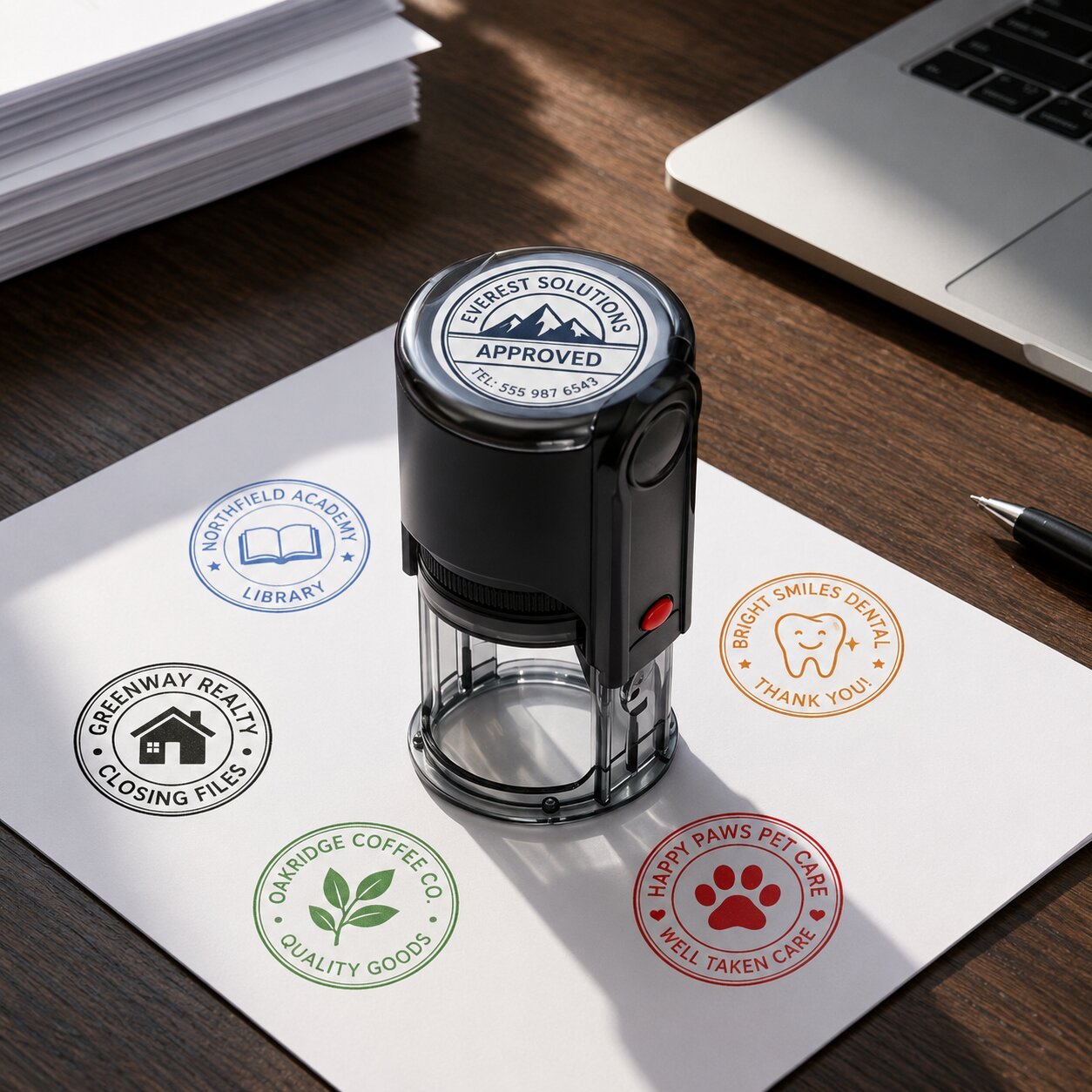
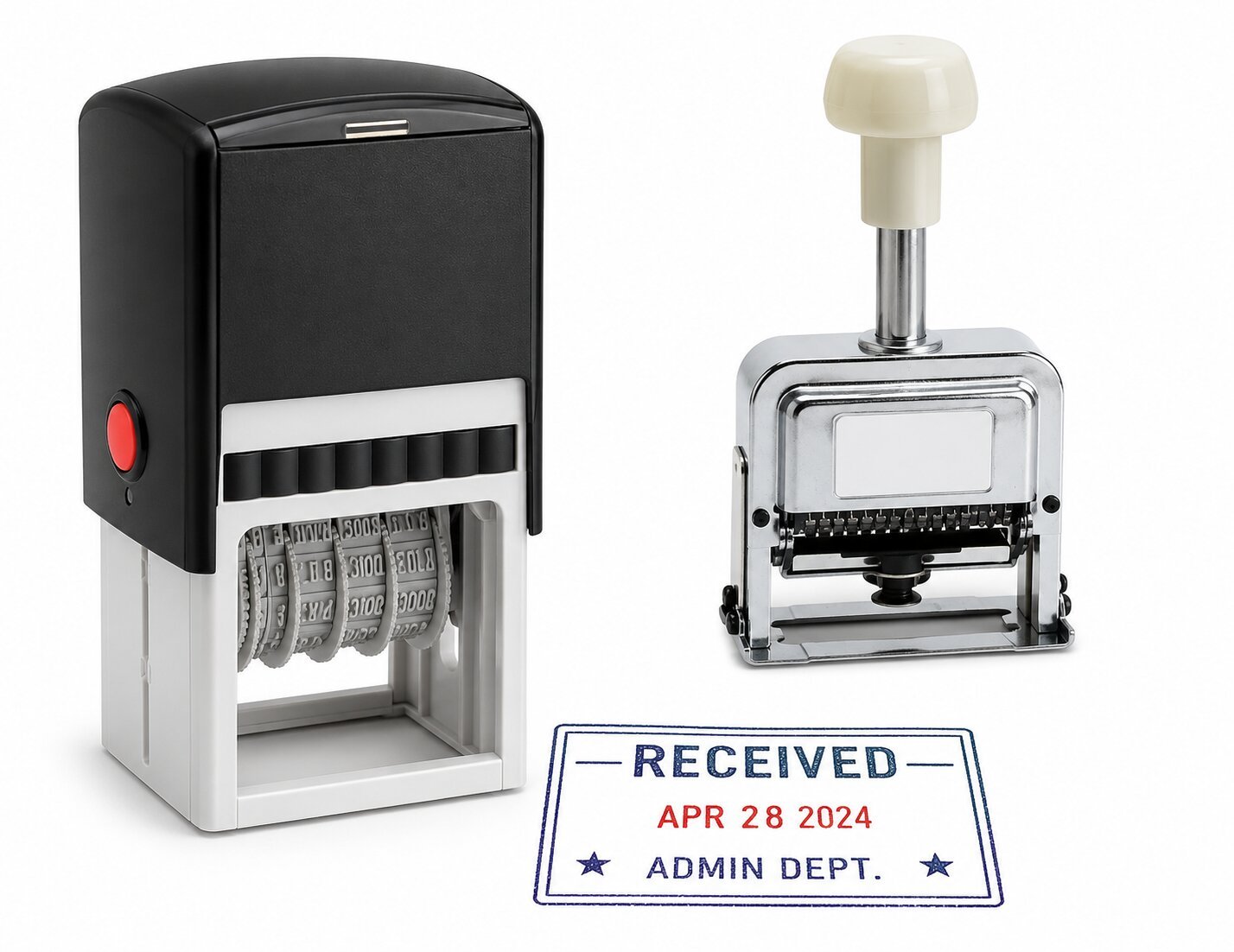
The workhorse of every UAE office. A spring-loaded body flips the die onto an internal ink pad after every strike, keeping impressions crisp for around ten thousand cycles before the pad needs replacing. Trodat Printy 4913 and Colop Printer 40 are our most-ordered sizes.

Best for: daily company stamping, invoice work

Pre-Inked Stamps

Ink is stored inside the die itself rather than a separate pad, producing a sharper, higher-resolution mark. Ideal for logo stamps and detailed Arabic script where dot-per-inch fidelity matters. Refill through a top valve without disassembly.

Best for: logo stamps, detailed calligraphy

Traditional Rubber Stamps

A laser-engraved rubber die mounted on a wooden or acrylic handle, used with a separate ink pad. The most economical option and the most flexible for oversized or unusual die shapes that will not fit a standard body.

Best for: occasional use, oversized artwork

Wax Seal Stamps

A solid brass head bearing a monogram, family crest or logo, paired with a wooden handle and colored wax beads. The pressed impression on cooling wax carries an unmistakably premium, tactile weight, especially popular for wedding invitations and gift packaging.

Best for: invitations, luxury gifting

Embossing Seals

A pincer-style hand tool that raises a paper crest without ink, creating an elegant tactile impression. Widely used for notary attestation, corporate document seals, chartered accountant certification, and university degree finishing.

Best for: notaries, certifications, degrees

Signature and Date Stamps

Combines a facsimile signature or bank endorsement mark with an adjustable date band. Standard in accounts departments, receiving warehouses and freight-forwarding offices that need to date-mark hundreds of documents per shift.

Best for: accounts, receiving, logistics

When You Still Need a Company Stamp in the UAE

Digital signatures and UAE Pass have replaced ink for most trade licence renewals, MoHRE labour approvals and Federal Tax Authority filings. A physical company stamp is however still expected — and often mandatory — in these situations:

  • Opening a corporate bank account with any UAE bank
  • Executing lease and tenancy contracts (Ejari registration and free zone leases)
  • Issuing wet-ink invoices, cheques and receipts on company letterhead
  • Notarising powers of attorney, board resolutions and shareholder documents
  • Signing off customs bills of entry at Dubai Trade, Jebel Ali and Khalifa Port
  • Attesting delivery orders, LPOs and warehouse receipts along the freight chain
  • Court filings, DIFC and ADGM legal submissions, and DED complaint procedures

Where Businesses Reach For A Stamp Every Day

Banking and Finance

Cheque endorsement, corporate account maintenance forms, wire transfer authorisations, and daily branch teller work.

Legal and Notary

Notary embossing seals, court filing stamps, chamber of commerce attestation and DIFC affidavit endorsements.

Real Estate

Ejari tenancy contracts, developer handover documents, RERA broker registration and property management office paperwork.

Healthcare and Clinics

DHA and DoH-facing prescription pads, medical certificate attestation, insurance claim endorsements and pharmacy dispensing logs.

Education

KHDA and ADEK-compliant transcript stamps, university degree embossing, school leaving certificate seals and equivalency documents.

Logistics and Freight

Delivery order marking, warehouse receiving stamps, customs broker endorsements and bonded goods release paperwork.

Weddings and Events

Wax seal envelopes for invitations, ribbon closures on gifting boxes, place-card branding and thank-you note finishing.

Retail and Hospitality

Loyalty card punch marks, gift packaging finishing, receipt endorsement, and menu revision date stamps in F&B outlets.

How To Choose Between Self-Inking, Pre-Inked, And Traditional Rubber

The right choice depends on volume, image complexity, and how often you want to touch a bottle of refill ink. As a rough rule, self-inking suits any office that stamps between five and fifty times a day and needs a clean, repeatable impression without fuss. Pre-inked stamps make sense when the artwork carries a photorealistic logo or dense Arabic diacritics that a rubber die would blur at low resolution. Traditional wooden-handle rubber stamps remain unbeaten on cost and on the freedom to engrave an unusually shaped die, and they are the natural choice for occasional-use scenarios such as an annual audit endorsement or a project-specific approval mark.

Longevity is another consideration. A self-inking body will last for years of daily use provided the internal pad is refilled at the correct interval. Pre-inked mechanisms have a slightly shorter usable life because the internal ink reservoir gradually degrades the die, but the impression quality throughout that life is superior. Traditional rubber dies effectively last as long as you look after them, though the separate ink pad becomes the disposable component. If you plan to change company details in the near future, a rubber die is inexpensive to replace and lets you retain the more expensive handle.

The Wax Seal Renaissance In UAE Weddings And Retail

Over the past five years wax sealing has quietly returned to prominence across the Emirates, driven by two very different customer groups. Emirati and expatriate wedding planners have embraced them for the ceremonial elegance a hand-pressed seal lends an invitation envelope, a favour box ribbon, or a place setting. Luxury retail and hospitality operators have adopted them for gift packaging inserts, loyalty rewards, and hand-written thank-you notes that stand out from mass-produced marketing collateral.

We supply solid brass heads engraved with jewellery-grade precision to preserve fine calligraphy and coat-of-arms detail. Wax is available in over forty colours including metallic gold, rose gold, burgundy, jet black, and sand ivory that references the desert palette. For high-volume weddings we recommend the glue-gun style wax sticks rather than traditional beads because a single team member can seal 200 to 300 envelopes per hour once a rhythm is established. Custom monograms are our most-requested engraving, followed by hospitality brand icons and family crests.

Bilingual Arabic And English Layouts Done Correctly

Making a bilingual company stamp is a design discipline in its own right. Arabic script sits below its imagined baseline and its diacritics extend above the cap line, so simply centring an Arabic phrase inside a circular die will leave the impression looking heavy at the top and thin at the bottom. Our design team applies visual weighting rather than mathematical centring, and we preserve tashkeel diacritics at engraving depth sufficient to survive tens of thousands of ink strikes without clogging with fibre or pad residue.

A properly built UAE company stamp typically carries the trade name in both languages, the trade licence number, the emirate or free zone of registration, and often a small brand icon in the centre. For DMCC, JAFZA, ADGM and DIFC registered entities, we include the free-zone identifier in the standard position their document controllers expect. For mainland DED companies, the LLC or Sole Establishment suffix appears immediately after the trade name in both languages. If you send us your trade licence in PDF form, our team can extract every required detail without you needing to type it out.

Technical Specifications

Type Common Sizes Impressions Per Refill Production Time
Self-Inking Round30mm, 40mm, 50mm~10,000Same day
Self-Inking Rectangular14x38mm to 30x69mm~10,000Same day
Pre-InkedRound, oval, rectangular~25,00024 to 48 hours
Traditional RubberAny custom shapeDepends on padSame day for standard
Wax Seal Head25mm, 30mm brassUnlimited (mechanical)2 to 3 working days
Embossing Seal41mm round standardUnlimited (mechanical)3 to 5 working days

Our In-House Manufacturing Process

Every stamp order begins with artwork preparation. If you send us your trade licence, logo file, or a rough sketch on a napkin, our design team produces a proof within a couple of working hours. Once approved, the design is written to a CO2 laser bed that engraves the die material to precise depth. Rubber plates receive shallower engraving so the ink transfers cleanly at moderate pressure. Brass wax seal heads and embossing dies are cut deeper because they must survive many years of repeated mechanical pressing without degradation.

After engraving, the die is trimmed, cleaned, and mounted into its housing. For self-inking bodies we install a factory-fresh Trodat or Colop ink pad in the customer's preferred colour. Each finished stamp is then tested on a proof card and the impression is checked against the approved artwork under magnification before packaging. This is a small step but it catches the rare occasion where a laser calibration drift produced a hairline defect. We would rather remake a stamp than send an imperfect impression out into a lifetime of daily use.

Ordering, Refills And Long-Term Support

The simplest way to order is by WhatsApp or email. Send us your trade licence for a company stamp, a vector logo for a branded gift stamp, or a description of your monogram for a wax seal. Our team will confirm the size, ink colour and price within a couple of hours during working days, prepare a digital proof for your approval, and dispatch or ready-for-collection notification typically within twenty-four hours of approval.

Long term, we keep records of every design we have made so reordering identical or slightly modified stamps takes minutes rather than starting from scratch. Refill ink bottles in the five most common colours are stocked at our office. Replacement pads for the Trodat Printy and Colop Printer lines are usually shipped same-day. If your company details change through a trade name update, address move, or free-zone jurisdiction change, we offer a paid re-plating service that keeps your familiar stamp body and just swaps the engraved die.

Bulk Orders For HR, Real Estate And Franchise Networks

Multi-branch businesses regularly place bulk orders for consistent stamping across their operations. A national real estate agency might need identical broker endorsement stamps for forty branches across the Emirates. A hospital group might order signature-and-date stamps for every clinical and administrative department. A hotel chain might need housekeeping inspection stamps and F&B date stamps for every property. Tiered pricing kicks in from ten pieces upward, with the deepest discounts applied at fifty, one hundred and five hundred piece orders.

For franchise networks and HR onboarding kits, we can pre-configure each stamp with the individual branch, department or personal identifier during manufacturing, and label each finished stamp with a barcode or QR code that maps back to a spreadsheet you provide. This service reduces the risk of a branch receiving the wrong stamp and eliminates the internal sorting step that traditionally lands on an office manager on the day of delivery.

Environmental And Refill Considerations

Modern self-inking stamps are designed to be re-inked and re-plated rather than discarded. A single Trodat or Colop body, correctly maintained, can serve a business for a decade or more. We encourage clients to refill rather than replace whenever their company details remain constant, and we accept old stamp bodies for responsible disposal when they finally reach end of life. Rubber dies and metal components are separated for recycling and only the plastic housing enters general waste.

Ink refills use standard water-based formulations that are safe for skin contact and comply with the same office-environment safety requirements as major stationery brands. For clients with specific requirements around VOC-free or oil-free formulations, we can source specialist inks on request. Wax used for sealing is composed of a resin, colouring pigment and a small proportion of natural or synthetic wax that softens under a low-temperature glue gun and cures rapidly at room temperature.

Ink Types Explained: From Standard Water-Based To Security-Grade UV

The ink you choose has more impact on how a stamp performs than most buyers realise. A poorly matched ink dries too quickly on the pad, feathers on glossy paper, or fades within months on documents kept in a filing cabinet. Water-based inks are the default across the UAE office environment and are what ship with every Trodat and Colop stamp we sell. They dry within a few seconds on uncoated bond paper, resist smudging under a moving hand, and remain vibrant in normal indoor storage conditions for many years. Water-based inks also clean up easily from fingers, desks and clothing, which matters when a busy accounts department stamps hundreds of invoices in a morning.

Oil-based inks are the second most common choice and are required whenever you need to stamp glossy stock, coated card, plastic loyalty cards, laminated forms, or non-porous packaging surfaces. The oil carrier prevents beading on non-absorbent surfaces and cures through evaporation rather than absorption. Oil inks take slightly longer to set on paper, typically thirty seconds to a minute, and should not be used on the same stamp body that already holds a water-based pad because the two chemistries do not mix. If you need both surfaces stamped, we recommend two separate stamps with clear labelling to avoid mix-ups at the desk.

Security inks form the third category and are commissioned for documents where authenticity matters more than convenience. Ultraviolet-only inks are invisible in normal light and fluoresce vividly under a black-light lamp, ideal for after-hours nightclub entry stamps, event access verification, and warehouse anti-counterfeit marking. Colour-changing thermochromic inks shift hue when heated by a finger or breath, useful for tamper detection on certificates. We also supply archival-grade pigment inks with lifetime lightfastness ratings for museum, notary and legal use where the impression must remain legible for decades of shelf storage.

The Trodat Versus Colop Debate: Which Ecosystem To Buy Into

Two Austrian and Slovakian manufacturers dominate the global self-inking stamp market and effectively define the ecosystem you commit to when you choose your first business stamp. Trodat, headquartered in Wels, Austria, holds the largest share of the UAE office supply chain by volume and manufactures the Printy 4900 series that most Emirati accountants would recognise on sight. Trodat replacement pads are stocked by every mainland stationery shop from Karama to Mussafah, refill ink is available in the widest colour range, and the housing survives being dropped on a marble reception floor without shattering.

Colop, based in Wels as well and often mistaken for a Trodat sub-brand, produces the Printer 40 and Expert Line series. Colop mechanisms tend to produce marginally sharper impressions at higher resolutions because the die-lifting geometry is slightly tighter, which makes a visible difference on Arabic diacritics and photorealistic logo stamps. Colop pads are widely available in the UAE but the colour range is narrower than Trodat, and refill ink is more commonly found in specialist office suppliers rather than general stationery shops. If you value refill availability across every corner store in the Emirates, Trodat is the safer long-term commitment. If you value impression sharpness on complex artwork, Colop rewards that choice.

Cross-compatibility of pads between the two brands is a common misconception. Some sizes will physically fit each other's housings but the ink-flow geometry differs enough that image quality degrades within a few weeks of misuse. We recommend staying inside one ecosystem for any given stamp and treating brand loyalty as a small ongoing cost that pays back in impression consistency and refill simplicity across the years of daily use.

How To Prepare Artwork That Produces A Clean Impression

The most common cause of a disappointing first stamp is artwork that was designed for print or screen rather than for stamping. A rubber die is a physical object with mechanical limits that a laser plotter and a Photoshop layer do not share. Understanding these limits before you send your file saves a proof revision cycle and often several days of back-and-forth. The single most important rule is minimum line thickness: no line, character stem or border stroke in your artwork should be thinner than 0.5 point at final stamp size. Anything thinner risks breaking during engraving or filling with pad residue after the first hundred impressions.

Fonts require particular attention. Serif faces with fine hairlines such as Bodoni or Didone families lose their thin strokes at stamp resolutions and impressions come out looking accidentally sans-serif. If your brand identity uses a fine serif, we recommend commissioning a bespoke stamp-safe version of your wordmark that thickens the hairlines just enough to survive the engraving process. Kerning is another quiet enemy. What looks tightly kerned on a business card at 200 point becomes an unreadable smear at 12 point stamp size. Loosen letter spacing by five to ten percent for anything intended to stamp below 20 point equivalent size.

For bilingual Arabic and English stamps, allow adequate leading between the two script blocks. Arabic characters descend below their baseline and English characters ascend above theirs, so eight points of leading that reads comfortably on paper compresses into an unreadable overlap on a 40mm round die. We typically double the leading on stamp artwork compared to print artwork and are happy to reflow your file accordingly if you send us the source. Vector artwork in SVG, AI, EPS or PDF format is always preferred because it scales cleanly to any die size. High-resolution PNG or JPEG files can be re-traced but the process introduces small imperfections that a careful reviewer will notice.

The Regulatory Timeline: How UAE Stamp Requirements Have Evolved

The role of the company stamp in UAE business life has shifted meaningfully over the past decade, and understanding this timeline helps buyers make sensible decisions about which stamps to invest in. Before 2018, a wet-ink company stamp was effectively mandatory on virtually every trade licence renewal, every MoHRE labour form, every bank cheque endorsement, and every commercial contract of any significance. Offices kept multiple stamps for different departments, different languages and different signature authorities, and losing a company stamp triggered notarised affidavit procedures similar to reporting a lost passport.

Between 2018 and 2020 the UAE Federal Government pushed a coordinated digital transformation across DED, MoHRE, FTA, GDRFA, and the free zone authorities. UAE Pass became the standard identity credential, digital signatures gained legal parity with wet-ink signatures under Federal Decree Law No. 46 of 2021, and the majority of routine trade licence, immigration and tax processes moved online. During this period some observers predicted the death of the office stamp within a few years. That prediction has not held.

What actually happened after 2020 is a stable hybrid environment. Banks retained the wet-ink stamp requirement for account opening, cheque endorsement and treasury paperwork because their internal compliance rules are updated more slowly than government portals. Notaries retained embossing seals for their own attestation work. Courts retained wet-ink filing stamps for physical case documents. Property owners retained tenancy contract stamping for Ejari-adjacent private lease work. The commercial reality across the seven Emirates in 2026 is that any business dealing with banks, courts, notaries, real estate or physical goods flow still needs at least one high-quality company stamp, and often needs several specialised ones for different departmental workflows.

Extending A Stamp's Life: Care, Storage And Refill Discipline

A well-made self-inking stamp will outlast most of the technology in your office if it is looked after with a small amount of discipline. Storage matters more than most people realise. Direct sunlight through an office window slowly bleaches the ink pad and warps the plastic housing. Extreme cold from an air-conditioned server room dries the pad prematurely. The ideal storage environment is a normal desk drawer at room temperature with the stamp resting cap-down so the die is not exposed to ambient air between uses.

Cleaning the die is a two-minute maintenance task that should happen every few months on a heavily used stamp. Paper fibre, dust and dried ink accumulate in the fine engraved channels and gradually fill the counters of letters, particularly Arabic diacritics and the enclosed spaces inside characters like B, O and D. A soft toothbrush with warm water clears the buildup and restores impression crispness immediately. Avoid solvents, alcohol and any household cleaner containing bleach as these damage the rubber compound. Between deep cleans, a quick blow of compressed air removes surface dust before it accumulates.

Refill discipline extends usable life more than any other single practice. Waiting until impressions become clearly faded before refilling actually shortens overall pad life because dry ink patches damage the pad substrate and cannot be reversed. We recommend adding a few drops of the correct colour ink through the top of the pad every three or four thousand impressions, well before the pad appears dry. Watch for the warning signs that indicate replacement rather than refill: uneven ink distribution across the pad surface, hard crusty patches that will not soften with fresh ink, or a persistent odour from the ink that indicates chemical breakdown.

Wax Sealing Techniques: Beads, Sticks And Glue Guns

Executing a wax seal well is a small physical skill that rewards practice. Three methods dominate: the traditional bead and spoon technique, the wax stick and open flame technique, and the modern glue-gun stick technique that dominates high-volume wedding and event work. Each has strengths, and choosing correctly for your project scale is the difference between an evening of joyful sealing and a stress-induced fingerprint on every third envelope.

The traditional bead and spoon method involves melting three to five wax beads over a small tea-light flame in a brass spoon, then pouring the molten pool onto the paper before pressing the brass seal head. It produces the most authentic finish, the deepest impression, and the best colour saturation because you control the pool depth precisely. It is also the slowest, requires patient technique, and is unsuitable for orders above about fifty seals in a single session unless you have multiple stations running in parallel. It is our first recommendation for hand-crafted wedding invitations of up to one hundred pieces.

The glue-gun stick technique uses a low-temperature glue gun loaded with wax sticks the same diameter as standard hot-glue cartridges. A trained operator can produce a uniform seal every six to eight seconds once technique is grooved in, making four hundred seals per hour achievable at a single station. The finish is nearly indistinguishable from the traditional method to a casual observer and completely acceptable to a wedding photographer at conversation-viewing distance. We recommend this method for corporate gifting runs above one hundred pieces, wedding stationery orders of any size, and hospitality group packaging inserts.

Colour psychology matters in the UAE market. Metallic gold reads as luxury and formality and is our most-ordered colour for Emirati weddings and hotel executive gifting. Deep red carries traditional ceremonial weight and works well for court and legal document sealing. Jet black is contemporary, minimalist and pairs well with monogram-only monochrome branding. Rose gold has surged over the past three years driven by wedding trends and now sits second only to metallic gold in our volume rankings. Burgundy, forest green and midnight navy round out the classic corporate palette for law firms and consulting practices that want gravitas without ostentation.

For clients seeking a truly bespoke finish, we blend two-tone wax pours in the same seal. A base pour of one colour is allowed to partially set before a second colour is added in a small spiral or splash, creating an organic marbled effect that no two seals will ever repeat exactly. This technique reads as unmistakably hand-made and is popular for boutique brand launches and limited-edition product packaging. Turnaround for two-tone sealing is slower because each seal requires two pour cycles, so we typically pre-schedule these runs and complete them with a dedicated production team.

Finally, a note on quality control that applies to every stamp and seal leaving our facility. Every finished piece is proof-tested at least once and, for higher-value orders such as embossing seals and brass wax heads, three impressions are compared under magnification against the approved artwork before packaging. If any impression falls outside our internal tolerance, the piece is remade at our cost. This discipline is why our reorder rate from corporate accounts sits above ninety percent year on year, and why our name is quietly passed between UAE office managers, HR directors and event planners as the maker who does not need chasing.

صناعة الأختام والأختام الشمعية في دبي والإمارات

نصنع في براندينغ بليتز جميع أنواع الأختام المخصصة في دبي وأبوظبي والعين والشارقة وجميع أنحاء الإمارات. تشمل خدماتنا الأختام الذاتية التحبير من ماركات ترودات وكولوب، والأختام المطاطية التقليدية، وأختام الشركات باللغتين العربية والإنجليزية للاستخدام المصرفي والقانوني والحكومي، بالإضافة إلى الأختام الشمعية النحاسية للأعراس والهدايا الفاخرة. نستخدم آلات الليزر الحديثة لنقش دقيق يحافظ على وضوح الطباعة لآلاف الاستخدامات. التسليم في نفس اليوم داخل دبي والتوصيل السريع لجميع الإمارات مع ضمان جودة الطباعة والدقة في التصميم.

Frequently Asked Questions

How long does a custom stamp take to make in Dubai?
Do UAE companies legally need a company stamp?
What is the difference between self-inking, pre-inked and traditional rubber stamps?
Can you make Arabic and English stamps in the same design?
What sizes and shapes are available for custom stamps?
How much does a custom stamp cost in the UAE?
Do you deliver stamps across all seven Emirates?
Can I refill or replace the ink in a self-inking stamp later?
Are wax seals suitable for wedding invitations and corporate gifting in the UAE?
+971 56 978 6395 info@brandingblitz.com Quick Enquiry Get Instant Quote
Follow Us