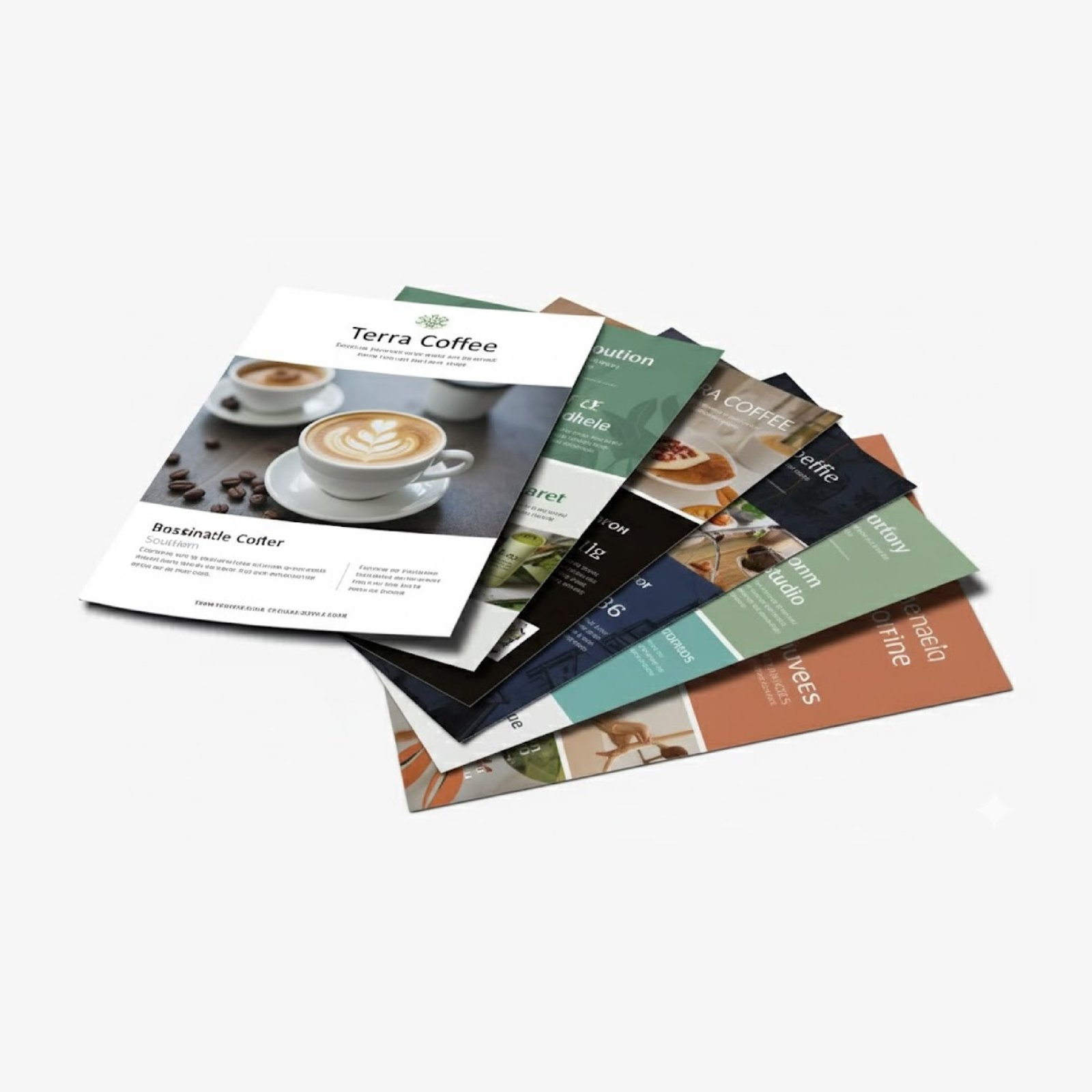
Pick the booklet size before the design starts. Relative costs, binding limits, paper weights and press sheet fit for A4, A5, A6 and square formats in Dubai.
Most booklet size decisions in Dubai get made backwards. Someone opens a layout file at A4 because that is the default, pours the content in, and only asks about size when the quote comes back higher than expected. We print booklets in house in Ajman for clients across all seven emirates, and the cheapest fix we see is also the simplest one: pick the booklet size first, then build the content to fit it. This guide walks through the formats we actually produce, what each one costs relative to the others, and the three questions that settle the choice in a few minutes.
The four booklet size formats we print most
Almost every job falls into one of four families. The dimensions below are the closed size, which is the size the reader holds.
| Format | Closed size | Typical page count | Best use | Relative cost per copy |
|---|---|---|---|---|
| A4 | 210 x 297 mm | 8 to 48 | Company profiles, catalogues, training manuals | Baseline |
| A5 | 148 x 210 mm | 8 to 64 | Event programmes, product booklets, menus | About 40 percent less than A4 |
| A6 | 105 x 148 mm | 8 to 32 | Pocket guides, loyalty booklets, instruction leaflets | About 60 percent less than A4 |
| Square | 148 x 148 mm or 210 x 210 mm | 12 to 48 | Lookbooks, hospitality, design studios | Between A5 and A4, plus trim waste |
The cost column is a guide, not a quote. Paper is the biggest single input, so a smaller booklet size saves money mostly because it uses less sheet area per copy. Square formats sit awkwardly on standard press sheets, which is why they carry a small waste premium even when the finished piece is smaller than A4.
Three questions that settle the booklet size
How will it travel?
A booklet handed across a reception desk can be any size. A booklet that goes into a jacket pocket at a trade show has to be A6 or a slim DL format, or it ends up in the bin by the exit. A booklet posted to clients should match a standard envelope, and an A5 booklet slides into a C5 envelope without folding, which keeps postage sane. If the piece will live in a presentation folder, A4 is the only format that fills the pocket properly.

How much do you really have to say?
Count the words and images before choosing. An A5 booklet at 16 pages carries roughly 2,500 words with modest imagery, which is enough for most product ranges and event agendas. If the draft runs past 6,000 words with technical diagrams, A4 stops being a vanity choice and becomes the practical one, because shrinking a schematic to A5 makes it unreadable. For long technical content we usually steer clients toward printed instruction manuals at A4 rather than forcing it into a smaller booklet size.
Who picks it up, and where?
A luxury property brochure left on a coffee table in a Palm Jumeirah sales centre earns its larger footprint. A pharmacy information booklet handed to a hundred people an hour does not. Match the booklet size to the moment. Bigger reads as more considered, smaller reads as more convenient, and neither is wrong until it meets the wrong setting.
Booklet size by industry, from our own job sheets
- Real estate: A4 or 210 mm square, 16 to 32 pages, heavy 170 gsm silk inside with a 300 gsm laminated cover. Developers want room for floor plans.
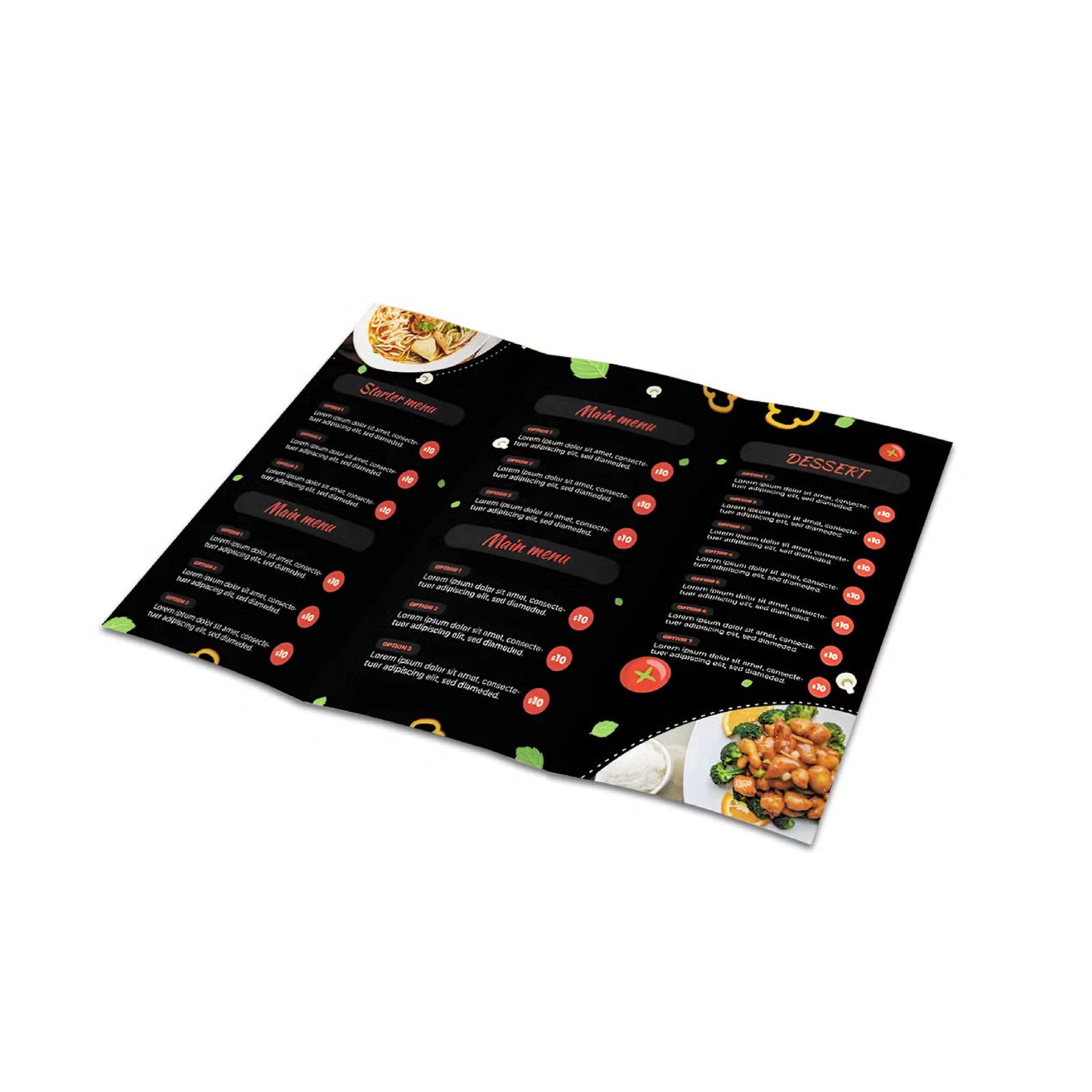
- Restaurants and cafes: A5 or a tall 148 x 297 mm cut, 8 to 12 pages, often on uncoated stock. Many outlets order printed menus this way and rotate them each season.
- Clinics and pharmacies: A6 and A5 patient leaflets, 8 to 16 pages, light 130 gsm so they fold into a bag easily.
- Schools and training centres: A4 workbooks at 24 to 64 pages, usually wire bound so they lie flat on a desk.
- Retail and consumer brands: A5 product catalogues at 16 to 48 pages, with a thicker cover for shelf life.
- Government and semi government: A4 in Arabic and English, with the binding on the right for the Arabic edition.
Need booklets priced for your quantity?
How binding limits the booklet size you can choose
Size and binding are tied together, and ignoring that link causes most reprint headaches.
A saddle stitched booklet is folded and stapled through the spine. It needs the page count to divide by four and works up to about 64 pages at A5 or 48 pages at A4. Beyond that the booklet creeps, meaning the inner pages push outward and the margins shift. We trim for creep, but a very thick saddle stitched booklet never sits flat.
Perfect binding, with a glued square spine, suits 48 pages and above at any size, and gives you a printable spine. It needs a minimum thickness to hold, so it is a poor fit for a 12 page A6 piece.
Wire binding handles any size and page count and lets the booklet open flat, which is why training workbooks and spiral bound diaries use it. The trade off is a less polished edge and no spine to print on.

Our booklet printing page lists the binding options next to each format, so you can see what is possible before the design starts.
Paper choices that change how a booklet size feels
Two booklets at the same size can feel completely different in the hand. For A4 and square formats, 150 to 170 gsm silk inside with a 300 to 350 gsm cover gives the weight people expect from a corporate piece. For A5 and A6, drop to 130 or 150 gsm inside, because a heavy stock in a small format turns stiff and springs open.
Uncoated stock photographs flatter under warm cafe lighting and takes handwriting, which is why hospitality clients prefer it. Gloss lifts product photography but shows fingerprints at a small booklet size that gets passed around. A matt lamination on the cover is worth the few fils per copy on anything that will be handled more than once.
If the project is really a one sheet message, a trifold flyer will cost less than the smallest booklet and do the same job. A folded card does the same for a short invitation or a price list. We will say so at quote stage rather than sell you pages you do not need.

Custom and odd formats
Custom formats are not expensive in themselves. What costs money is a size that wastes sheet area or needs hand finishing. A 200 x 200 mm square or a 120 x 240 mm tall format imposes neatly on our sheets. A 180 x 260 mm booklet wastes a strip on every sheet and the waste gets priced in.
Ask us before the designer locks the artboard. We can suggest a booklet size within a few millimetres of the idea that fits the press sheet cleanly, which often saves 10 to 15 percent on paper for the same visual result. The same logic applies to brochures of any size. It applies even more to multi page magazine printing, where a few millimetres of waste repeats across every signature.
Artwork setup for each booklet size
- Set the document to the closed size with facing pages, not as a single spread.
- Add 3 mm bleed on all sides and keep text 5 mm inside the trim.
- Export at 300 dpi in CMYK, with fonts outlined or embedded.
- For Arabic editions, mirror the layout so the booklet opens from the right.
- Supply the page count as a multiple of four for a saddle stitched booklet.
Send the PDF by WhatsApp or email and we return a printed proof or a soft proof before the run. Minimum runs for booklet printing start at 50 copies on our digital presses, and lead time across the UAE is usually two to four working days for standard formats. Browse the magazines and books range to see finished examples. The wider booklet printing in the UAE page shows an A5 booklet next to its A4 and A6 equivalents so you can judge the scale.
Ready to get started?
Look, we have been in this business long enough to know what works and what doesn't. If you are not sure where to begin, just give us a call. No pressure, no sales pitch. We will walk you through the options and give you an honest quote.
What you get with us:
- Straight answers about what you actually need (not what costs most)
- Fair pricing. We will tell you how to save money where it makes sense
- Quick turnaround when you need it, or save by planning ahead
Need Booklets in the UAE?
Our team produces booklets and related print for businesses across Dubai, Abu Dhabi, Sharjah and every emirate. Send us your brief for a same day quote.
Get Your Free Quote+971 56 978 6395
Atiya Naaz
Marketing Head, Branding Blitz
Atiya brings five years of hands on experience in the UAE printing and branding industry. Based in Abu Dhabi, she leads marketing team at Branding Blitz, helping businesses across Dubai, Abu Dhabi, Sharjah, and all emirates find right print solutions for their branding needs. Her expertise spans corporate identity materials, exhibition printing, packaging design, and digital marketing strategy for the regional market.
Related resources: See our brochures & books and magazines & books pages for specifications, quantity pricing and design options across the UAE.