Most print disappointments are visible on the sample. Nine checks that separate quality printing from a cheap job before the full run leaves the press.
Anyone can judge a print job after 5,000 copies are sitting in boxes. The useful skill is judging it from one sample, before the run is approved and the invoice is due. Most of the complaints we hear about print services in Dubai, from muddy colour to cards that crack along the fold, were visible on the proof. Nobody looked, or nobody knew what to look for.
This is the checklist our own production team uses before a job leaves our Ajman press, rewritten for the buyer. It works whether the supplier is us or anyone else offering print services in Dubai, and it takes about ten minutes with a sample, a ruler and daylight. Each check names the fault it catches and what fixing it after the run would cost.
Where to run the checks
Ask for a physical sample on the actual stock, not a PDF proof and not a sample on a different paper. For business cards and flyers that is one printed sheet or a single finished piece. For brochures and catalogues it is one folded and trimmed copy. Look at it in daylight, because warm office LEDs hide a yellow cast. Most print services in Dubai will supply one on request. If a supplier will not before a run above AED 1,500, that tells you something too.
Nine checks for any print services in Dubai
1. Colour against the brand reference
Hold the sample next to the last job that was signed off, or a Pantone swatch of the brand colour. A shift is normal between digital and offset, and quality printing keeps it small, but a red that turns orange or a navy that goes purple means the file was supplied in RGB or the press was not profiled. Fixing it after the run is a complete reprint, so this check alone justifies the ten minutes.
2. Solids and large tints
Look at any area of flat colour bigger than a palm. It should be even from edge to edge. Banding, mottling or a slightly lighter patch in the middle points to a worn blanket, low ink density or cheap uncoated stock drinking the ink unevenly. On flyers with a full colour background this is the first fault customers notice.

3. Registration
Find small black text sitting on a coloured background, or a thin coloured outline. Under a loupe or a phone camera zoomed in, the colours should sit exactly on top of each other. A halo of cyan or magenta beside black text means the plates were out by a fraction of a millimetre, and small type will look soft to the naked eye across the whole run.
4. Paper weight and feel
Weigh a stack if you can. A 350 gsm business card should feel rigid and snap back when flexed. If the quote said 350 and the card bends like 300, the supplier has substituted stock. For brochures the usual pairing is a 300 gsm cover with 150 or 170 gsm inner pages. Hold one inner page up to the light. If the print on the reverse shows through clearly, the paper is lighter than specified or lower opacity than quality printing demands.
5. Trim accuracy
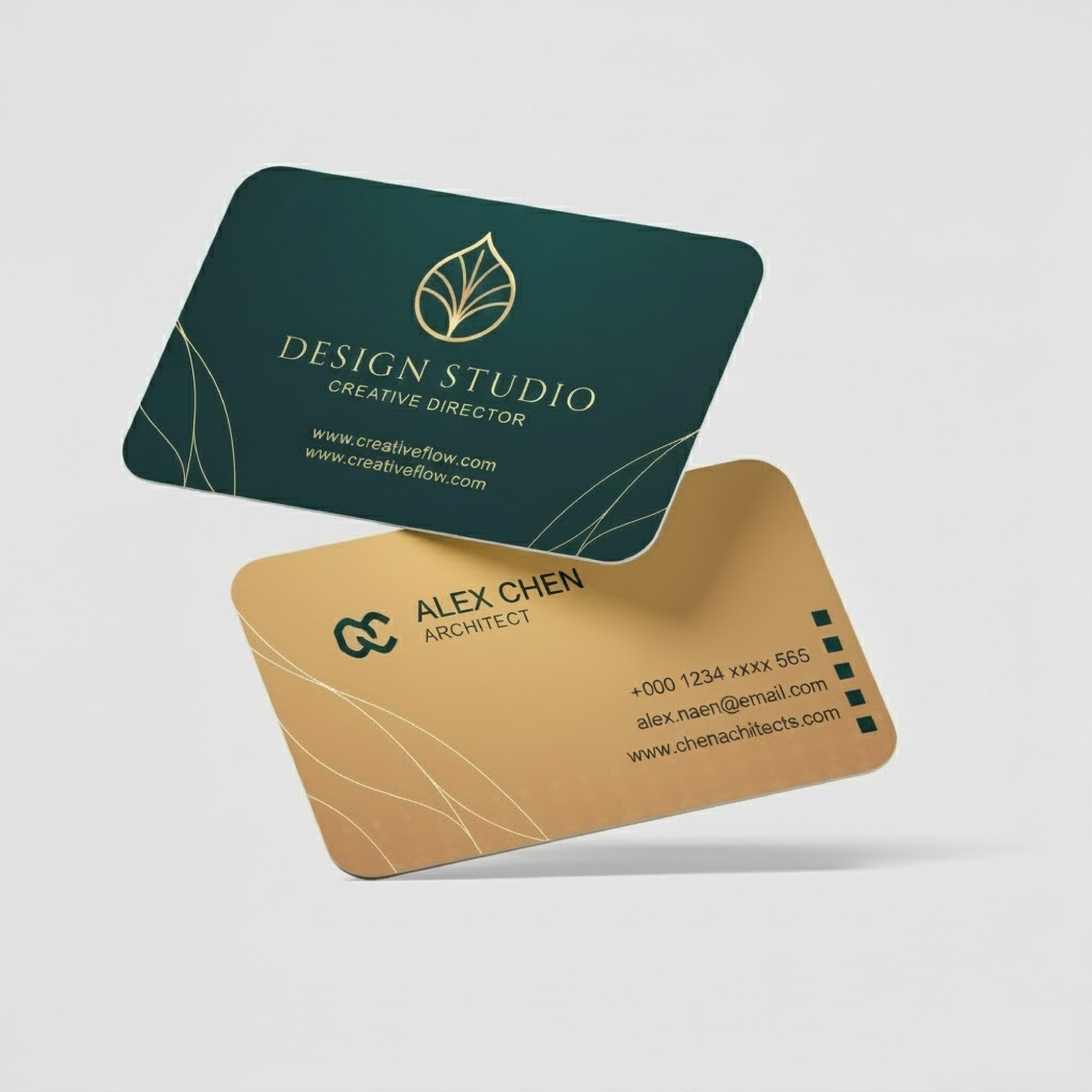
Measure the finished piece. A 90 by 55 mm business card should be within half a millimetre. Check that borders are equal on all four sides and that nothing important sits within 3 mm of the edge. Uneven borders on foil business cards or any card with a frame design are the most common reason for rejection, and they come from the artwork lacking bleed as often as from the guillotine.
6. Folds and creases
On anything folded, open and close the fold three times and look at the spine. Cracking along a fold on coated stock means it was not scored before folding. White fibres showing through a dark colour on the fold is the same fault. Trifold flyers in 170 gsm should fold flat without a score. Anything heavier needs one, and a good printer does it without being asked.
7. Finishing alignment
Spot UV, foil and embossing are applied in a separate pass, so they can drift from the printed image underneath. Hold the sample at an angle to the light. The gloss or foil should sit exactly on the element it was meant to cover. A 0.5 mm shadow on spot UV cards is visible to anyone who picks one up, and it cannot be corrected after the fact.
8. Lamination and coating defects
Lamination is where cheaper print services in Dubai cut corners. Run a thumb across the laminated surface. It should be smooth with no bubbles, silvering or lifting at the corners. Matt lamination that scuffs when rubbed with a fingernail is too thin.
9. Binding and page order
Binding is the stage print services in Dubai most often subcontract, so check it closely. For catalogues, booklets and anything with more than one sheet, flick through and check every page is present, in order and the right way up. Saddle stitched books should have staples exactly on the spine and the inner pages trimmed so they do not creep past the cover.
What each fault costs to fix after the run
| Fault | Fix after printing | Typical cost impact |
|---|---|---|
| Wrong colour | Full reprint | 100 percent of the job |
| Out of register | Full reprint | 100 percent |
| Trim out by over 1 mm | Recut if bleed allows, else reprint | 10 to 100 percent |
| Cracked folds | Reprint on scored stock | 100 percent |
| Finishing misaligned | Reprint, finishing cannot be removed | 100 percent plus finishing |
| Missing or disordered pages | Rebind if sections are intact | 15 to 40 percent |
The table explains why the sample matters more than the quote when comparing print services in Dubai. A 10 percent saving on price disappears the moment one of these faults reaches the client.
Need brochures priced for your quantity?
Questions that reveal good print services in Dubai
Alongside the sample, three questions sort print services in Dubai quickly.
- Which press will this run on? Short runs of business cards and flyers belong on a digital press. Runs above about 2,000 brochures or 5,000 flyers belong on offset for both cost and colour consistency.
- Will you score before folding? On 250 gsm and above the answer must be yes.
- What is your tolerance on trim and colour? A real answer sounds like half a millimetre and a Delta E under 3. A vague answer means there is no tolerance, which means there is no checking.
Our printing in Dubai page lists the equipment we run and the stock we keep, which makes the first question easy to answer. The digital printing page covers where short runs make sense.
Cost without losing quality
Quality printing does not have to be the expensive option. Print services in Dubai are priced on setup and sheet count, so the cheapest reliable moves are to gang several items onto one sheet, so letterheads and compliment slips print together, to choose standard sizes that fit the press sheet without waste, and to order quarterly rather than monthly so each run clears the setup cost. Letterheads at 1,000 cost little more per sheet than 250 for exactly this reason. Finishing is where budgets go wrong. Choose one finish that earns its place rather than three that fight each other.
Approving the run
Once the sample passes the nine checks, sign it and keep it. It becomes the reference for the whole run and for every reorder. We attach the signed sample to the job ticket in Ajman and match reorders to it, so the five hundredth box of flyers looks like the first. A full list of what we print is on the marketing materials page. It runs from business cards to large format. Quotes go out on WhatsApp with a sample offered on any order above AED 500, and we deliver to all seven emirates. Good print services in Dubai are not hard to find, but the sample is still the only proof that counts.
Ready to get started?
Look, we have been in this business long enough to know what works and what doesn't. If you are not sure where to begin, just give us a call. No pressure, no sales pitch. We will walk you through the options and give you an honest quote.
What you get with us:
- Straight answers about what you actually need (not what costs most)
- Fair pricing. We will tell you how to save money where it makes sense
- Quick turnaround when you need it, or save by planning ahead
Need Brochures in the UAE?
Our team produces brochures and related print for businesses across Dubai, Abu Dhabi, Sharjah and every emirate. Send us your brief for a same day quote.
Get Your Free Quote+971 56 978 6395
Atiya Naaz
Marketing Head, Branding Blitz
Atiya brings five years of hands on experience in the UAE printing and branding industry. Based in Abu Dhabi, she leads marketing team at Branding Blitz, helping businesses across Dubai, Abu Dhabi, Sharjah, and all emirates find right print solutions for their branding needs. Her expertise spans corporate identity materials, exhibition printing, packaging design, and digital marketing strategy for the regional market.
Related resources: See our brochures & books, magazines & books and business cards pages for specifications, quantity pricing and design options across the UAE.