
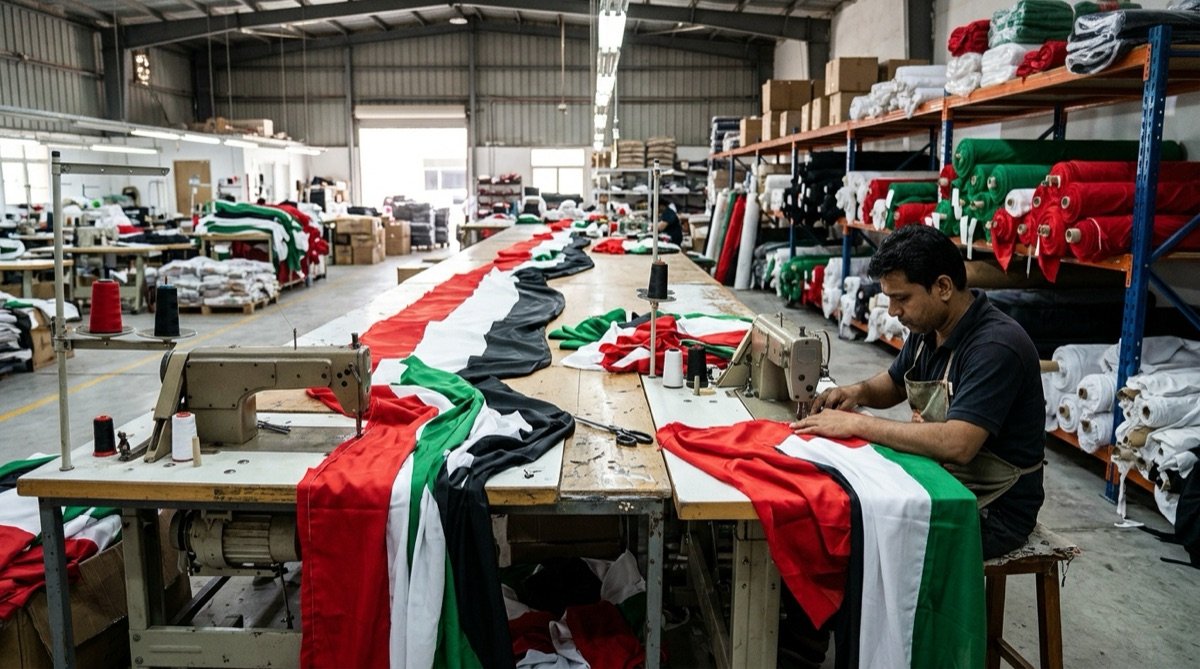
Why is the back of a flag paler than the front? Nine production steps from artwork to hem explain it, with sizes, fabrics and the right method for each type.
- Step 1: flag printing begins with the type, not the artwork
- Step 2: artwork sized to the finished flag
- Step 3: fabric decides how the print behaves
- Step 4: flag printing methods, sublimation, digital or screen
- Step 5: single sided, double sided or blockout
- Step 6: cutting, hemming and reinforcement
- Step 7: hardware matched to the site
- Step 8: quality check and packing
- Step 9: delivery across the UAE
- What this means when you brief a flag printing company
A flag looks like the simplest thing we make: fabric, ink, a hem. Then a client asks why the back of their flag is paler than the front, or why the red on the pole flag does not match the red on the teardrop beside it, and the answer sits in one of nine production steps most buyers never see. This is the flag printing process as it runs in our Ajman workshop, from the file you send to the hem we stitch, with the decisions at each step that change the price and the result.
Step 1: flag printing begins with the type, not the artwork
The shape fixes the size, the hardware and the print method, so it comes first. Buyers often send a square logo and ask for "a flag", which sends us back to this step anyway. The types of flags we produce fall into four working groups:
- Advertising flags on their own poles: teardrop, feather, sail, blade and telescopic, from 2 to 5.5 metres tall.
- Outdoor and national flags for fixed poles and walls: hoisting flags, wall mounted and stadium formats, typically 90 by 180 cm up to 3 by 6 metres.
- Decorative and event flags: pennant flags, bunting strings, festival flags on fibreglass poles, and car flags.
- Hand and table flags: hand flags on plastic sticks, table flags with chrome bases, conference sets.
Step 2: artwork sized to the finished flag
Each of the types of flags has a template, and we send it on request. The artwork is built at full size or at a clean scale such as 1 to 10, with 2 cm of bleed on all sides for the hem to take. Vector logos are essential for anything over a metre; a raster logo that looks fine on a business card turns soft at 3 metres. Colours are set in CMYK with a Pantone reference for each brand colour, and text stays 10 cm away from the pole edge on advertising flags because the sleeve hides that strip.
One habit saves money: design for the standard sizes in the table below. A custom size means custom hardware, and hardware is where flag printing quotes jump.
| Flag type | Common finished sizes | Fabric | Usual print method |
|---|---|---|---|
| Teardrop | 2.3, 2.8, 3.4, 4.5 m tall | Knitted polyester 115 gsm | Dye sublimation |
| Hoisting flag | 90 by 180, 120 by 240, 150 by 300 cm | Knitted polyester 115 to 155 gsm | Dye sublimation, double sided for logos |
| Pennant string | 20 by 30 cm triangles, 5 to 10 m string | Polyester or paper | Dye sublimation or digital |
| Hand flag | 14 by 21, 20 by 30 cm | Polyester 75 gsm | Digital, or screen for bulk |
| Table flag | 15 by 22 cm | Satin polyester | Dye sublimation |
Step 3: fabric decides how the print behaves
Across all types of flags, knitted polyester is the workhorse of flag printing because ink penetrates it well and it flies in light wind. Woven polyester holds shape for wall mounted and indoor flags. Satin gives a sheen for table flags and ceremonial pieces. Mesh is for exposed coastal sites where wind load would tear a solid fabric. The fabric also sets how much colour reaches the reverse, which leads to the next decision.

Need tear drop flags priced for your quantity?
Step 4: flag printing methods, sublimation, digital or screen
Three methods cover almost all flag printing in Dubai and the wider UAE, and each suits a different job.
Dye sublimation
The design is printed in reverse onto transfer paper, then pressed against the polyester at around 200 degrees Celsius. The dye turns to gas and bonds inside the fibre rather than sitting on top, so the colour does not crack, peel or wash out, and the reverse shows the image at roughly 85 to 90 percent strength. This is our default for anything that lives outdoors or needs photographic colour.
Direct digital printing
Ink goes straight onto the fabric from a wide format printer. It allows a single flag with no minimum and handles fine detail, but penetration is lower, so the reverse reads noticeably lighter. Good for one off indoor pieces and for paper or coated fabrics that cannot take sublimation.
Screen printing
One screen per colour, pushed through the fabric by hand or machine. Uneconomic below a few hundred pieces but the cheapest route for 2,000 one colour hand flags, and the ink saturates both sides.
Step 5: single sided, double sided or blockout
This is the step behind the pale back complaint. A single sided sublimated flag shows a mirror image on the reverse at reduced strength; for a symmetrical logo that is acceptable and it is the cheapest option. Where text must read correctly from both sides, as on car flags or a hoisting flag with a slogan, we print two panels and sew them back to back with a blockout liner between them. Double sided roughly doubles the fabric cost and adds weight, which matters for how a flag flies in light wind. We state which option we have quoted on every flag printing estimate so there is no surprise at delivery.

Step 6: cutting, hemming and reinforcement
After pressing, the fabric is cut to the template, usually by a heat knife that seals the polyester edge so it does not fray. Hems are double folded and stitched; on outdoor flags the fly edge, the side furthest from the pole, gets four rows of stitching because that is where flags fail first. Advertising flags get a sleeve sewn down the pole edge with a reinforced tip pocket. Hoisting flags get a white header tape with brass grommets or a rope and toggle. Pennants and bunting flags are stitched onto a continuous tape with loops at each end.

Step 7: hardware matched to the site
A finished flag without the right pole and base is a sail. For advertising flags the pole is fibreglass or aluminium in sections, and the base is chosen by surface and wind: a concrete base for open ground, a cross base with a water bag for paved event sites, a ground spike for grass and sand. Festival flags on fibreglass poles simply push into grass or sand at a desert camp. Hoisting flags need a halyard pole, which is normally the client's own. Hand flags get plastic sticks with a safety cap. We quote hardware as a separate line so that a repeat order of fabric alone is clear.
Step 8: quality check and packing
Each flag is checked against the approved proof for colour, size and stitch count, then folded with tissue so the creases do not set in the heat of a delivery van. For runs of hand flags we count by weight after a sample count. Advertising flags travel in a carry bag with the pole sections, and the base is boxed separately.
Step 9: delivery across the UAE
Flag printing in Dubai makes up most of our orders, and from our Ajman workshop they arrive usually within a day of completion, as do Sharjah and Ajman. Abu Dhabi, Al Ain, Ras Al Khaimah, Fujairah and Umm Al Quwain take two. Most flag printing jobs run three to five working days from proof approval; double sided flags add a day, and large hand flag runs on screen add two to three.
What this means when you brief a flag printing company
Any of the flag printing companies in the UAE will quote faster and more accurately if the brief covers the nine steps above in one message: type, finished size, where it will fly, whether the back must read correctly, and the quantity. Online printing forms rarely capture that detail, so we take enquiries for flag printing in Dubai and every other emirate on WhatsApp and reply with a scaled proof. For the full range, see our flags collection. For National Day stock go straight to UAE flags.
Flag printing is simple once the nine decisions are made, and the fabric will show every one you skipped.
Ready to get started?
Look, we have been in this business long enough to know what works and what doesn't. If you are not sure where to begin, just give us a call. No pressure, no sales pitch. We will walk you through the options and give you an honest quote.
What you get with us:
- Straight answers about what you actually need (not what costs most)
- Fair pricing. We will tell you how to save money where it makes sense
- Quick turnaround when you need it, or save by planning ahead
Need Tear Drop Flags in the UAE?
Our team produces tear drop flags and related print for businesses across Dubai, Abu Dhabi, Sharjah and every emirate. Send us your brief for a same day quote.
Get Your Free Quote+971 56 978 6395
Atiya Naaz
Marketing Head, Branding Blitz
Atiya brings five years of hands on experience in the UAE printing and branding industry. Based in Abu Dhabi, she leads marketing team at Branding Blitz, helping businesses across Dubai, Abu Dhabi, Sharjah, and all emirates find right print solutions for their branding needs. Her expertise spans corporate identity materials, exhibition printing, packaging design, and digital marketing strategy for the regional market.
Related resources: See our event flags, flags and outdoor flags pages for specifications, quantity pricing and design options across the UAE.


